
Why E-Commerce Brands Don’t Need Another Chatbot (They Need an AI Operator)
Most AI tools give store founders homework instead of doing the work. Discover how autonomous commerce operators replace the 60-hour back-office click tax with direct catalog mutation, human-in-the-loop safety gates, and plain-English business intelligence.
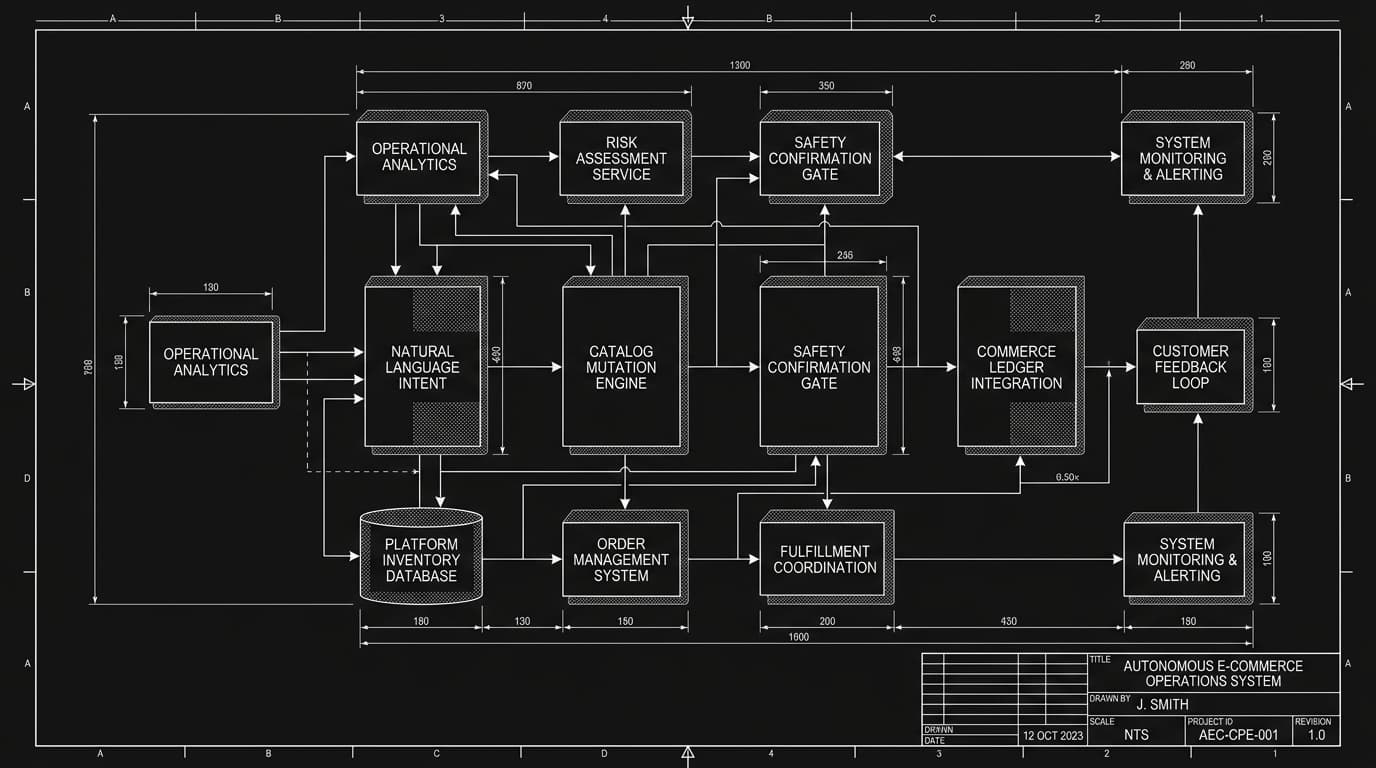
If you run an online retail brand, you have almost certainly experimented with AI over the past two years to help manage your business. And almost every e-commerce founder has encountered the exact same bottleneck: You ask an AI tool how to fix lagging conversion rates on your winter collection. The tool instantly generates a beautifully structured, 8-point bulleted list advising you to 'optimize your meta descriptions, create a tiered bundle discount, email your inactive 60-day segment, and audit low-margin stock levels.'
You read the list, close the browser window, and realize the cold reality: you still have to spend the next 4 hours manually doing every single one of those tasks yourself. The AI didn't do the work. It simply assigned you homework.
Modern DTC founders and brand managers don’t have time for more theoretical brainstorm partners. Operating a store already consumes 60+ hours each week juggling suppliers, shipping delays, ad creative decay, and customer service. What contemporary e-commerce requires is an AI Operator—an autonomous control engine that doesn't just discuss store operations, but actively executes them.
1. The Devastating Cost of the 'Admin Click Tax'
Running an e-commerce brand involves hundreds of repetitive micro-actions every single week across multiple dashboards. In conventional platforms like standard Shopify or WooCommerce, each operational decision requires logging into an administrative portal, navigating three layers of nested menus, manually typing in input fields, and repeatedly saving records one by one.
- ›Creating collections and tagging seasonal items across 50+ variant combinations.
- ›Adjusting wholesale and retail prices across 40 SKUs for a 48-hour flash sale.
- ›Archiving out-of-stock items so paid ad traffic doesn't hit high-bounce dead ends.
- ›Cross-referencing SKU inventory levels against real-time sales velocity across fulfillment centers.
- ›Configuring and testing multi-tiered promotional coupon codes (e.g., BUY2GET10, VIP20).
When brand owners spend 60% of their working hours acting as high-priced manual data-entry clerks, genuine strategic growth grinds to a halt. You cannot innovate on product or negotiate supplier terms when you are trapped updating CSV spreadsheets at 11 PM.
An AI Operator flips this dynamic entirely. Instead of clicking through twenty dropdown menus, you issue a concise business objective in plain English: 'Archive all items with zero available stock, compile an Autumn Essentials collection containing all outerwear SKUs, and register a 15% discount code called FALL15 for carts over $50.'
A true commerce operator translates that natural prompt into atomic control-plane mutations: querying catalog relations, assembling the collection taxonomy, validating margin thresholds, registering the discount rule, and confirming deployment in seconds.
2. Unified Commerce Memory vs. The 'App Fatigue' Trap
The modern e-commerce tech stack is an expensive architectural mess. The average merchant runs between 8 and 14 disparate SaaS plugins: one tool for bulk price changes, a second for inventory reorder alerts, a third for SEO schema generation, and a fourth for cart discount logic. Each plugin extracts a recurring monthly fee, but the deeper cost is systemic fragmentation.
None of these disconnected tools share a synchronized state or business memory. When you run a flash sale via one app, your inventory forecasting tool has zero awareness of why demand spiked, leading to erratic reorder recommendations and unexpected stockouts.
How operational execution engines transform daily retail management
| Operational Dimension | Generic AI Chatbots (ChatGPT / Claude) | Autonomous AI Operator (Orbit) |
|---|---|---|
| Catalog Management | Drafts copy and CSV formats that you must manually copy, format, and upload. | Directly queries, updates, bundles, and archives live catalog SKUs via API. |
| Promotions & Discounts | Suggests theoretical discount percentages based on generic formulas. | Synthesizes, tests, and deploys validated checkout discount rules with margin safety checks. |
| Merchandising | Explains textbook concepts of product grouping and visual merchandising. | Dynamically builds collections, sorts by profit velocity, and attaches matching products. |
| Inventory Intelligence | Offers generic guidance on inventory turnover ratios and carrying costs. | Audits live inventory ledgers, highlights dead capital, and automates supplier purchase orders. |
| Execution Mechanism | Passive text output inside a siloed chat window. | Two-phase transactional commit directly against the store backend with human safety gating. |
An AI Operator bridges this gap because it lives directly on top of the commerce data ledger. It continuously reads inventory levels across warehouses, historical order velocity, customer lifetime value segments, and landed product margins. It does not treat your store like a hypothetical textbook case study—it operates on your actual business reality.
3. Human-in-the-Loop: Sovereign Safety Without Slowdown
The single greatest hesitation store owners have regarding autonomous AI systems is loss of sovereign control: What if the AI accidentally marks a luxury watch at $0.00? What if an errant discount rule applies a 90% markdown store-wide and annihilates gross margins overnight?
This is why a production-grade AI Operator is built with a deterministic Two-Phase Commit architecture and mandatory Safety Confirmation Gates. The agent never blindly executes destructive or margin-critical mutations.
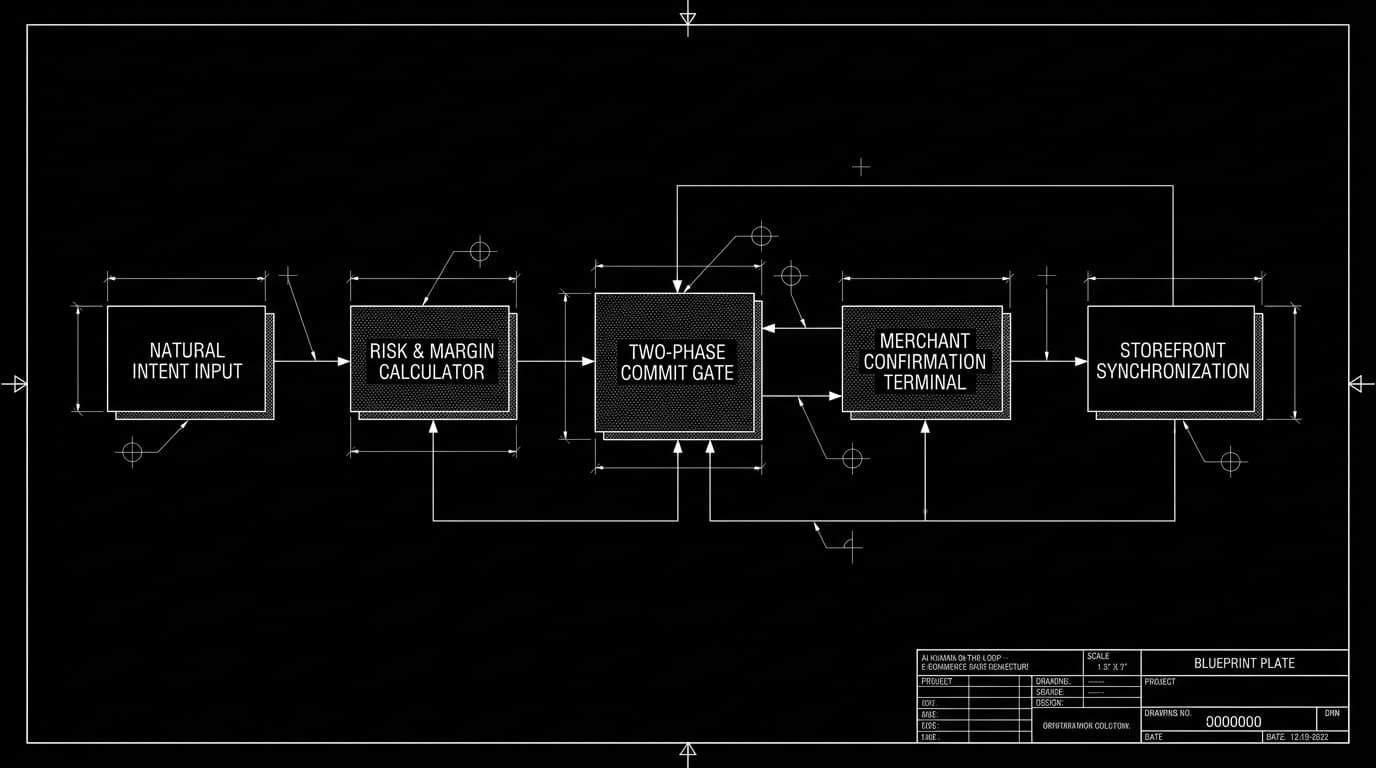
When you instruct an AI Operator to modify pricing or launch promotions, the system follows a structured pipeline: (1) parses the operational intent, (2) calculates the financial impact against landed product costs, (3) simulates customer cart checkout, and (4) presents a concise specification plate to the operator for explicit one-click approval.
// Deterministic Safety Confirmation Gate Payload
{
  "operation": "BULK_PRICE_MUTATION_AND_PROMO",
  "affected_skus": 24,
  "action_summary": "Set retail price to $19.99 & register coupon FLASH20",
  "margin_impact": {
    "current_gross_margin": "64.2%",
    "projected_promo_margin": "48.7%",
    "minimum_margin_floor": "35.0%",
    "margin_safety_status": "PASSED"
  },
  "risk_assessment": "LOW",
  "requires_confirmation": true,
  "mutation_state": "PENDING_MERCHANT_APPROVAL"
}
High-consequence mutations—such as store currency changes, bulk price overwrites across hundreds of SKUs, or discounts exceeding 40%—can never bypass this gate. You gain the 100x execution speed of autonomous AI while maintaining absolute sovereignty over your retail financials.
4. Plain-English Business Intelligence & Closed-Loop Auditing
Every e-commerce founder understands the agony of monthly financial audits: exporting raw 50,000-row CSV spreadsheets from Shopify, Stripe, and ad networks, opening Google Sheets, and spending hours calculating which products actually generated positive cash flow after ad spend, return shipping, and merchant fees.
Modern data dashboards are built for data analysts; store owners simply need actionable clarity. Instead of forcing you to hunt through static charts, an AI Operator synthesizes telemetry and provides direct diagnostic conclusions in plain English.
Instead of wondering why net margins dipped despite gross revenue surging, you simply ask: 'Why did net profit fall 6% this week?' The AI Operator traces the ledger, cross-references ad spend per acquisition with refund rates, and answers directly: 'Meta Ad CAC for the Summer Linen collection increased 34% while returns on Variant Small doubled due to sizing feedback. Recommend pausing Ad Set 04 and adjusting size guide guidance.'
The Verdict: Moving from Passive Advice to Autonomous Execution
The first era of generative AI taught business owners how to draft blog posts and generate synthetic product photography. While helpful, it barely scratched the surface of real commercial friction.
The next era of e-commerce belongs to operational execution. In an increasingly competitive landscape where paid customer acquisition costs continue to climb, winning brands will not be the ones burning 20 hours a week trapped in back-office administration. They will be the brands that empower their teams with an autonomous AI Operator—automating catalog maintenance, stock alerts, and promotional execution in seconds, so humans can focus entirely on craft, brand equity, and product innovation.
Frequently Asked Questions
- [Q]What is an E-Commerce AI Operator?
- An E-Commerce AI Operator is an autonomous agent system that directly connects to your store's backend ledger (Shopify, WooCommerce, Amazon). Unlike conversational chatbots that only offer text advice, an AI Operator executes actual store actions—such as creating collections, adjusting variant pricing, creating discount codes, and forecasting inventory replenishment—via secure API mutations.
- [Q]How does the AI Operator prevent costly mistakes or accidental discounts?
- Through a deterministic Two-Phase Commit architecture and Human-in-the-Loop confirmation gates. The AI analyzes the operational command, computes the projected gross margin impact, and generates a structured confirmation preview. Destructive operations (bulk price changes, high discounts) require one-click human approval before touching the live database.
- [Q]Can an AI Operator replace existing e-commerce apps?
- Yes. By consolidating catalog management, bulk price editing, inventory alerts, and promotional logic into a single conversational control plane, an AI Operator eliminates the need for 5 to 10 disconnected third-party plugins and their monthly subscription fees.
- [Q]How does Orbit support e-commerce brands?
- Orbit for E-Commerce provides a unified workspace that bridges your product catalog, real-time sales ledger, and warehouse inventory. Founders and operators execute multi-step retail workflows through natural language prompts with complete safety, full code ownership, and zero dashboard fatigue.
[ CROSS-REFERENCES · EXPLORE RELATED ARCHITECTURAL GUIDES AND E-COMMERCE SOLUTIONS: ]
Build with Orbit AI Developer Workspace
Connect live databases, generate native Expo mobile codebases, and eliminate fragmented subscriptions inside one continuous environment.